Monday, June 10, 2019

Ready.....Go!

"You Make Possible"
My first day at Cisco Live was off to a great start with arriving for the opening keynote from Chairman and CEO of Cisco Systems, Chuck Robbins, to an exciting setup using what else but technology to choreograph music and lights to hype the crowd. Shortly into his address, he made the statement, "technology is at the heart of everything", which is hard to disagree with. A  number of top Cisco leaders spoke on different areas during the keynote presentation including enterprise networking, IoT, innovation in DNA center, and how AI and ML will assist with the complexity in our networks.

"Pace of Change"
As the day has quickly rolled on, the IT Management track fired up and has been filled with thought provoking sessions and speakers. One in particular that I enjoyed was Susan Gueli, SVP/CIO of Infrastructure & Operations and Digital Transformation & Enterprise Applications for Nationwide. She started with discussing the exponential pace of change by using a grain of rice example, which says to take a checkerboard and start with two grains of ride and double every other square and after 64 squares, she threw out a number I can't even pronounce, but let's just say you have lots of rice. It puts into perspective the challenges in front of us as we deal with the rapid pace that technology continues to change our landscape. Another takeaway from Susan's talk that I appreciated was "focus first on what you know, not what you don't know". Her point was to let what you know propel you forward and tackle the "what you don't know" along the way.

Girl Power
A first for Cisco Live was a group of high school girls from Arizona's Paradise Valley School District presenting on cyber security. Their knowledge and wisdom was very evident and one of the girls comments on how it is going to take the perspective from more than just one group of individuals to solve problems was very profound.   

Employee Tenure
The last session I attended today was Leading Talent in the Digital Age, presented by Steve Cadigan, Talent Expert, Collaborated End Users. Steve's a great public speaker and was very engaging in his delivery and content. His shared examples of today's workforce and the challenges with employee tenure were relevant and informative. One of Steve's examples of retaining employees was a company that reversed the bring your child to work day and instead had a bring your parents to work day. Think about that for a moment, he said the companies retention went up.

Sunday, June 9, 2019

First BBQ: Cisco Live

Newbie
This year will be my first visit to Cisco Livc, taking place in cool San Diego, California! Although the dry AZ heat has not fully kicked in yet, the thermometer has been on the rise and it is always nice to visit any city on the coast. As you have probably already deduced from the post title, this is my first time attending Cisco Live and from what I have been told, it is a fun filled learning experience that should not be missed. 

The Track
Having attended ISTE for many years, another very large conference with more of an educational technology focus, I understand how easy it is to spend time aimlessly walking around lost if you don't have somewhat of a plan. Instead of spending endless hours looking through the session catalog I was given a tip to sign up for the IT Management Track as a starting point. This turned out to be a great piece of advice as the schedule actually fell very in line with sessions I would have chosen. The session filter has also been beneficial in filtering by category and allowing me to find collaboration and security sessions that I am interested in for this maiden voyage to the event. 

Keep Posted
I am going to do my best to post a daily update from the event as a way to do that quick reflection that is key to getting the most out of any event or professional development. With the enormous amount of content being presented this week, it is easy to be exposed to much and remember little, so use a system that works for you. 
In the short time I have been here I have already had the opportunity to build my very own lego dude, that is a sign of great things to come. #clus @CiscoLive 

Sunday, November 25, 2018

Password Envy

123456
Marco Verch CC By 2.0

You guessed it, "123456" is the most commonly used password of 2017, followed by "password" in the runner-up spot. SplashData releases their annual list of the worst passwords based on their collection of over 5 million passwords leaked by hackers, according to a Fortune article posted in December of 2017. Although the 2017 list has been out for a while, it hardly changes from year to year and the struggle to educate users on a good password seems to never go away.

How Often?
Another piece of the password puzzle that is open for debate is how often should we change our passwords. A little research will show that best practices have moved over the years from every 30 days to 90 days and most recently in a released document by the National Institute of Standards and Technology, are recommending the removal of periodic password change requirements. Is it better to never require a password change or require frequent password changes that lead to habits that ultimately make our passwords meaningless? We all know the quickest way to retrieve a password in an office or classroom setting is to first check for the sticky note under the keyboard or in the top drawer of the desk. One step better is when the password is written in Sharpie on the bottom of the keyboard, and if there is a requirement to change passwords often, the previous passwords are crossed out with the newest in plain sight.

Passphrase or Password?
Another practice that NIST recommends moving away from is complex passwords with multiple special characters and number combinations. Extending the number of characters to 64 and encouraging the use of a passphrase to make it easier for the user to remember a passphrase unique to them. I agree with the logic behind this recommendation, however, it must be accompanied with some basic rules to ensure that the passphrase isn't easily compromised by context clues around the user's desk or office. A quote on the wall or a sticky note with my favorite animal in the desk drawer can still be a give away for someone physically looking for a password.


CC BY-NC 2.0 Duncan C
Weakest Link
There are numerous studies that show people are the weakest links in cybersecurity breaches. Generic passwords, standard new user account passwords, not having a way to require global password changes, and the lack of password education are all areas that we need to address. Each area has its own unique set of challenges but starting with our organization's users will provide a strong front line of defense in the cybersecurity battle. Don't wait, have the conversation today! 

Sunday, August 26, 2018

Island Life


Tropical Paradise
I want to talk about island life for a moment and full disclosure, I have never lived on a remote island, so no offense to those who have. Living on a remote tropical island really sounds good though, at least for a short amount of time, but long-term, being on an island can become isolating. Not interacting with others, sharing, and working alongside peers that challenge you, will keep us from growing as individuals and we can become stale.

Stay Fresh

It is easy to become isolated on internal islands within our own technology departments. With the grind that comes with answering help desk tickets and trying to maintain normal daily responsibilities while pushing ahead with additional projects, communication between our peers becomes increasingly more difficult. If we layer on top of that the rapid pace that technology changes and the amount of content generated on a daily basis, the island starts feeling like a safe place to be. We all know however that isolation will not help us solve the problems in front of us, keep us fresh with new ideas, and increase collaboration amongst our peers to better serve our students and staff. 


PLN Strong
The concept of a professional learning network has been around for quite some time now and still, in my opinion, the most effective way to connect with peers. The power of a PLN is the informal manner that a person can participate, share content as well as consume, and take advantage of a global community. Having a staff that has strong PLN's will benefit our internal technology teams that often struggle with getting out and allows that isolated island feeling to creep in. Although the PLN and PLC terminology is synonymous with teachers and administrators, there is a vast community of technology-related professionals waiting to connect. A few places to connect with other technology-related professionals.
  • Twitter: Search hashtags, ie. #itdirector, #networkadministrator, #datasecurity, #programmer
  • LinkedIn
  • COSN: Consortium for School Networking
  • ISTE: International Society for Technology in Education
  • State and local listservs 

Creative Time
I am not sure that creative time is a thing, my point here is that time is the magical piece that there is never enough of. Instead of using the old saying that you will find time for what is important, be creative with time and find different ways to get together other than the traditional meeting. A recent post on Engage, an employee engagement blog, on "7 Fun Ways to Host Team Meetings", points out a variety of simple common sense ways to make meetings not boring. Three of my favorites are mentioned below that I have added some ideas on how to make these easily happen with minimal time involved in preparation. 

  • Use grouping: We know birds of a feather flock together right, so instead of having everyone count off from 1-5 then split up, which is boring, pass out different pieces of candy to everyone when they arrive and find their table of like sugary fun. Substitute anything you would like if candy isn't your thing. 
  • Change the scenery: This one is very self-explanatory and why not meet at the local coffee shop, nothing makes a meeting more enjoyable than sitting in a comfortable chair with an iced coffee. One notable mention here is as the leader, you need to reassure your leadership team that this is OK. Let them know your expectations, traveling an hour across town to a nice speakeasy is probably not what counts as productive for most organizations. 
  • Switch up positioning: This is similar to grouping in moving people out of their comfort zone by not having them sit in the same exact chair every week. Here is where you need to lead by example, the next time you walk into the meeting room, you start it off by sitting in a different spot every time. If we expect others to venture out of their comfort zone, we must lead by example.

Sharing is Caring
I would love to hear what others are doing with their staff for staying fresh, building their PLN's and being creative with time. Leave a comment, tag me on Twitter @jcastelhano, share the great things you are doing!


Friday, July 20, 2018

Soft Skills vs Tech Skills

Dark Cave
One of the most common things I have heard from business owners about high school students is the lack of soft skills they possess. The technical skills are there and they can learn, but it is difficult to teach the soft skills. The issue is not specific to high school students, but in the tech world, that generalization has been there for many years. The dark caves stories that make up an IT shop exists for a reason, many are like that. If you only know that your help desk ticket goes into a secret cyberspace and eventually someone assists without any human contact, is a giveaway that your IT department is operating under the dark cave model. This model does not promote soft skill expectation or development.

Tech Savvy?
Make no mistake, hard or technical skills are necessary to keep any environment running smoothly for the end users. Problem-solving, project management, coding, and technical writing are all important hard skills that make this possible. Under good leadership, mentoring, and training, these hard skills can be learned by a motivated person. The question becomes can someone be taught the soft skills necessary to balance and provide the best customer support possible to the end user? In January this year, LinkedIn released the "The Skills Companies Need Most in 2018-And The Courses to Get Them". Top four soft skills include leadership, communication, collaboration and time management. According to LinkedIn, 57 percent of leaders say soft skills are more important than hard skills, makes sense in a customer service focused environment. 

Organizational Chart     
We know the dark cave model does not work in today's world, but what organizational structure best works for an IT department to provide the best end-user support with customer support as the ultimate goal? If we are working to shed the stereotype of the dark cave, then our IT team needs to be visible and accessible to the end users. So where do we start with setting the customer service expectations desired?

Job Description
When researching job descriptions recently for technicians that are in the field with our end users I noticed that technical skills are still the priority. It was not until I searched for "customer care representative" that I found the soft skills listed on job descriptions that are needed for any technology department to be successful. If we are going to set an expectation that relationships are the number one priority for our teams, then soft skills should be on the top of any application.
  • Positive attitude
  • Build and maintain positive relationships with students, staff, and stakeholders
  • Go the extra mile to engage end users
  • Greet customers warmly 
  • Customer orientation and ability to adapt/respond to different types of users
  • Resolve end-user issues via an in-person visit, phone, help desk, or email, based on the individual needs of the user
Get Out
It is not a new concept that creating an environment that places end-user support at sites, allows access and relationships to develop between end users and technical services support. Knowing that shoulder to shoulder support is nearby is comforting for those that still feel they are not good with technology and at the same time gives the early adopters a place to bounce ideas and be innovative knowing someone has their back when needed.

Soft skills and relationships are not an option, they are key to a successful customer care environment. Take the time and step out of the dark cave and look around, you may find it is a great place to be!     

Sunday, November 26, 2017

Computer Science For AZ?


It's Been Awhile
I have to say that this has been the longest absence of blog posts that I have had since I began blogging in 2010. I am currently in my second year at Gilbert Public Schools and my last post was the same month I began my new position, so I have been a bit busy making the transition. However, no more excuses, it is time to get back to sharing, collaborating, and growing on the Interweb.

CS for All
If you have been following Computer Science (CS) for the last couple of years, you are most likely familiar with the various CS initiatives at the federal and state levels. President Obama brought attention on the federal level when he addressed the need for better CS education in his 2016 State of Union Address and followed with his initiative calling for $4 billion in funding and $100 million to districts for teacher training, materials and partnerships. We all know now that $4 billion was not committed too, however, the attention brought to the topic and movement from smaller initiatives have continued to gain momentum and CS initiatives are growing across the country. The current administration under President Trump, in September 2017, issued a memorandum directing the Department of Education to spend $200 million in grants to supporting STEM programs, including CS. Ivanka Trump, who is an adviser to the President, has also been active in supporting STEM education and more specifically for girls. In September, Ivanka, Hadi Partovi (Code.org), and Brad Smith (Microsoft President), visited an elementary school in Virginia to discuss women in STEM fields, Hour of Code, and support for CS in schools with students. This type of awareness and support will need to continue from multiple levels to move CS for all and STEM related education in the right direction.

Why CS
I often hear the question, why is CS important for our students, not all students are going to become coders. True, not all students will be interested in coding, but CS is more than coding and the computational thinking process applies to more than CS. Computational thinking is about the process of solving a problem and potentially using technology for the outcome. The process involves collecting and processing data, looking for patterns, creating the steps to solve the problem and testing the solution for accuracy and efficiency. These are skills that all students can use in a variety of disciplines.

If we take a look at the data around open computer science jobs in the United States, from an economic and innovative perspective, we are in danger of falling behind the curve. According to the Conference Board's Help Wanted Online service, there are around 500,000 CS openings across multiple industries and states. With CS career opportunities being the second highest paid starting salaries according to the National Association of Colleges and Employers, where is the disconnect?

The State of CS
Code.org is a non-profit organization that has been a leader in the vision that every student in every school should have the opportunity to learn computer science. The Hour of Code was launched by Code.org in 2013 and today millions of students in over 180 countries participate in the event during Computer Science Education Week yearly. Code.org also tracks CS policy and implementation across the United States which provides valuable information in a central location for stakeholder access. A deeper dive into the statistics reveals that only 10 states have currently adopted CS standards and in 34 states CS can count towards high school graduation math or science requirements. If we take a look at the current job openings and percentage of graduates in STEM fields with computer science, we will have a lack of workforce to meet the demand and this affects innovation in our country.

CS for AZ
Arizona is seeing momentum towards CS for all in the K-12 school setting and for good reason. There are currently 9,677 open computing jobs in AZ and with only 546 computer science graduates in 2015, the numbers speak for themselves. Of all AZ schools in 2015-16, only 10% offered AP computer science courses and this amounted to the least number of AP tests taken in any other STEM subject area. Of the 438 AP tests that were taken by students, only 23% were female and 68 were underrepresented minorities. Not only are these two demographics underrepresented, but we are missing their perspective, which is something we need to change.

CS for AZ, a non-profit organization, is working with a large group of stakeholders to bring CS to all students in AZ. The organization has brought together a diverse group of educators, AZ government, business leaders, college-level educators and students, working together to provide information and support for CS standards in the state. The positive movement towards their goal can be seen, the Arizona Department of Education has recently opened the call to collect public feedback that will help guide the development of K-12 Computer Science Standards. The working groups that will be formed to develop these standards will represent K-12 educators, higher education, parents, and industry representatives in a collaborative process to ensure the standards represent a diverse population.

Skills
If we want to provide a relevant education for our students we should be supporting them with the skills and exposure necessary to be able to leave the K-12 setting prepared to pursue whatever path they choose. Computer Science skills are not limited to coding but can be used to reinforce such areas as problem-solving, data collection, testing, and analysis, in engaging ways that can apply to a variety of disciplines. Working together we can provide the opportunities for our students to have the skills to solve today's problems and tomorrow's challenges, in whatever capacity they choose.

Saturday, July 16, 2016

The State of Digital Citizenship

The Big Four
Over the years I have worked hard at providing a reliable environment to support K-12 staff and students in a relevant and meaningful learning community. A simple rule of thumb that I have done my best to follow is focusing on what I have called, "the Big Three". The Big Three is made up of three categories: infrastructure, devices, and professional development. As the years have passed and mobile devices have found their way into the hands of all staff and students, the Big Three is no longer enough, enter the new “big” on the block, digital citizenship.
Digital citizenship is not new, but in many cases it has not been part of the foundation when creating technology plans, nor has it been part of the conversation at administrative team meetings. However, we can no longer ignore that the number of student devices in the classroom is on the rise. By the 2016-17 school year, half of all school districts in the US will be 1:1 with mobile devices, according to Futuresource Consulting. This fact, combined with the decreased cost of mobile devices, means that digital citizenship must be taught and addressed.
Where Are We?
In the state of AZ, Jeff Billings, technology director at the Paradise Valley School District, has generated a bit of buzz around digital citizenship. Billings has created the Arizona Digital Citizenship Statewide Data Collection Project and hopes to have all students in the state represented when the project is complete. He has already collected data from over 250,000 students; the plan is to begin sharing the data next fall after the results have been disaggregated. The goal is to have a reliable source of information on digital citizenship across the state and promote further discussion and collaboration.


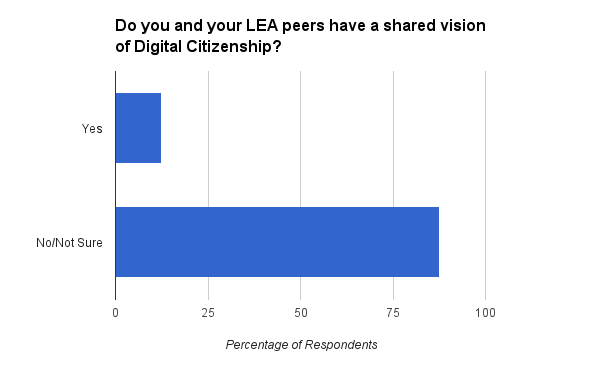
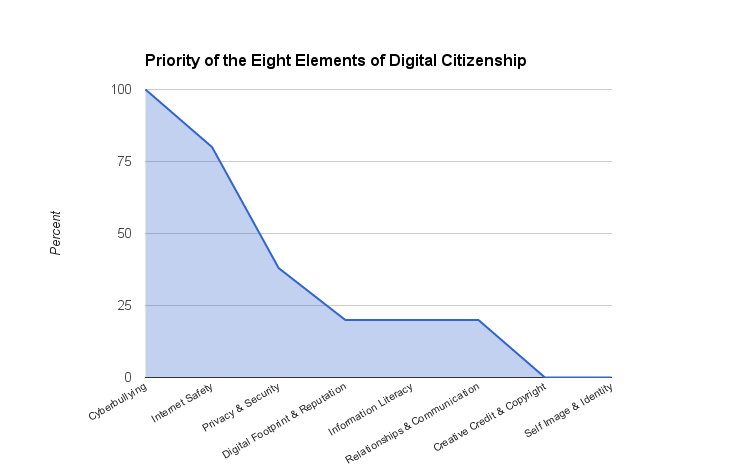
The picture painted by some of the early data shows that the local education agencies are at various places with respect to a shared vision of digital citizenship implementation in the classroom. It appears that a shared vision within districts is not the norm, which should prompt concern among all stakeholders. The way in which respondents prioritized the eight elements of digital citizenship is also notable. To be consistent in the delivery of digital citizenship, is any element more or less important than the other?
This project holds promise for bringing together districts from across Arizona and providing talking points that could lead to positive collaboration and common language among educators. We should applaud the effort and look forward to the data.

Moving Forward
It is becoming clearer everyday that digital learning is on the rise, even if our schools do not provide these opportunities. The 2014 SpeakUp Survey showed that 75 percent of students think every student should have access to a mobile device during the school day to support learning. Many of them have taken matters into their own hands, as 58 percent already use their own smartphones in class and perform such tasks as taking photos of assignments and textbook pages.
So where do we start with such an overwhelming responsibility that affects our classrooms and the teachers that ultimately set the example for our students? A quick Web search will return numerous sites with digital citizenship resources. Common Sense Media is a popular choice and offers scope and sequence materials that are age appropriate for the classroom and a certification program for educators and schools. It takes much more effort, however, to find actual programs that exist in schools-examples of digital citizenship embedded in those teachable moments that are so relevant to our students. We need to shared successful programs and hold them up as models for others to see (#digitalcitizenship).      


A Partnership
Digital citizenship is no different from good citizenship in general-the only distinction is the medium where that community exists. If we expect our students to be responsible members of the digital community, we have to collaborate with all stakeholders to create successful learning opportunities, encourage parental support, lead by example, and include our students in that discussion. Technology is no longer a once-a-week event or a trip to the computer lab; it is embedded in our classroom and personal environments. It will take more than the librarian or tech teacher to instill the values of digital citizenship into the lives of our students and make good digital citizenship part of the Big Four.