Showing posts with label Professional Development. Show all posts

Tuesday, November 19, 2019

Round 1

Reflection
If there is one constant over the years that I have found most valuable for growth and improvement is reflection. Without taking the time to give serious thought to our daily decisions and practice, improving them will be difficult and the same results will be achieved.

Over the years I have been asked to answer questions around technology for peers working on their higher education degrees. The questions are usually similar enough that It is enjoyable to look back and see how my answers have changed and also create a blog post out of it, cause why not. I am going to split this one up as it was quite lengthy, enjoy!

Leadership and Vision
The biggest hurdle to developing a shared vision for technology use in today’s K-12 landscape is the divide between the Teaching and Learning and Information Technology departments. Historically the goals of these two areas have not been communicated to one another and the communication breakdown will lead to a lack of understanding of what is important for planning a meaningful and effective path for technology integration and a safe online learning environment for users. 
In Gilbert Public Schools we have an organizational chart that
allows for all-district departments to be represented at the Cabinet-level
including the Teaching and Learning and Information Technology
departments. Having the Executive Directors and Assistant Superintendents at the table allows for each area to be represented, communicate their needs and understand the importance of the IT side to ensure a safe network, protect student and staff data, and provide support to meet strategic plan goals.

Gilbert Public Schools has created a strategic operating plan that has technology e
mbedded to achieve the ultimate goal of, success for all students. Each area of focus, safe and supportive schools, family and community engagement, employee excellence, and financial and operational efficiency all have goals and action items in place that are measured to monitor progress and allow for modification when needed.

Technology is embedded in each of these areas but is only a small piece of supporting our student’s success. Ultimately, it is the relationship between teachers and students and the support provided by leadership that will allow us to measure the true success of the plan.  


Team Building and Staffing The same philosophy that applies at the district level for cross-functional departments is necessary within an Informational Technology team structure. The rapid rate of change that takes place with technology is difficult to communicate at times and does lead to issues with bringing awareness to end-users. In the GPS Technology Services department, there are 5 internal teams to include: IT Customer Care Specialists, Information Systems, Network and Telecommunications, Systems Administration, and Instructional Technology. Each leader of these areas plus a Project Specialist make up the Technology services leadership team. The Executive Director of Technology meets weekly in a formal meeting with the team and daily on an informal basis. This team is responsible for working closely with one another to ensure Technology Services is working collaboratively to support GPS. One example of this would be the leadership team working with one another to coordinate occasional cross-functional team meetings. They create an agenda around issues happening with end-users, ways to address them and share other problems or successes happening in the field. 

GPS Technology Services has also established a userXperience team that meets regularly to discuss and make decisions on existing and future implementations, device functions and features, updates, and other variables as it relates to the end-users in GPS. This group has representation from all Technology Services departments and is important to our end user’s success with implementations and integrations that impact the daily function of staff and students. We have been able to make changes and roll back changes based on the feedback they bring to the table representing each area of the department. 
      Instructional Focus and Professional Development
Bringing awareness to all staff members around emerging technologies and potential issues to protect the network and data is on-going. I agree with the philosophy of leading from the middle and that everyone is a leader regardless of their position. We encourage all Technology Services staff to share ideas, emerging technologies they see and support to everyone around them. Our Instructional Technology team works closely with site Principals to present at staff meetings, meet one on one with teachers, attend grade-level meetings, share a weekly newsletter and any other form of communication that leads to awareness. 

Another example from the department level is our yearly awareness campaign around Computer Science Week. For the last three years, the Technology Services department has provided support around CS by providing professional development activities, meet-ups, video campaigns, and support for our teachers to bring CS into their classrooms. 

There is not a one size fits all approach with learning and the same applies to the technology that can support the educational outcomes our teachers want for our students. 

Round 2
Thanks for taking the time to read a bit on what started as assisting a friend with their doctorate assignment to gaining a little glimpse of how we do things in Technology Services. There is not any secret sauce being served up here, just a good group of individuals working together for students. See you soon for Round 2. 


Saturday, July 16, 2016

The State of Digital Citizenship

The Big Four
Over the years I have worked hard at providing a reliable environment to support K-12 staff and students in a relevant and meaningful learning community. A simple rule of thumb that I have done my best to follow is focusing on what I have called, "the Big Three". The Big Three is made up of three categories: infrastructure, devices, and professional development. As the years have passed and mobile devices have found their way into the hands of all staff and students, the Big Three is no longer enough, enter the new “big” on the block, digital citizenship.
Digital citizenship is not new, but in many cases it has not been part of the foundation when creating technology plans, nor has it been part of the conversation at administrative team meetings. However, we can no longer ignore that the number of student devices in the classroom is on the rise. By the 2016-17 school year, half of all school districts in the US will be 1:1 with mobile devices, according to Futuresource Consulting. This fact, combined with the decreased cost of mobile devices, means that digital citizenship must be taught and addressed.
Where Are We?
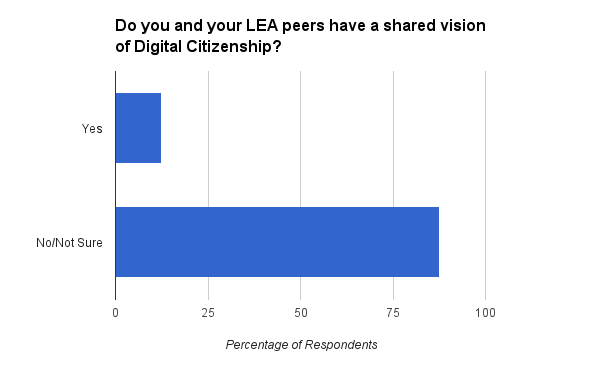
In the state of AZ, Jeff Billings, technology director at the Paradise Valley School District, has generated a bit of buzz around digital citizenship. Billings has created the Arizona Digital Citizenship Statewide Data Collection Project and hopes to have all students in the state represented when the project is complete. He has already collected data from over 250,000 students; the plan is to begin sharing the data next fall after the results have been disaggregated. The goal is to have a reliable source of information on digital citizenship across the state and promote further discussion and collaboration.


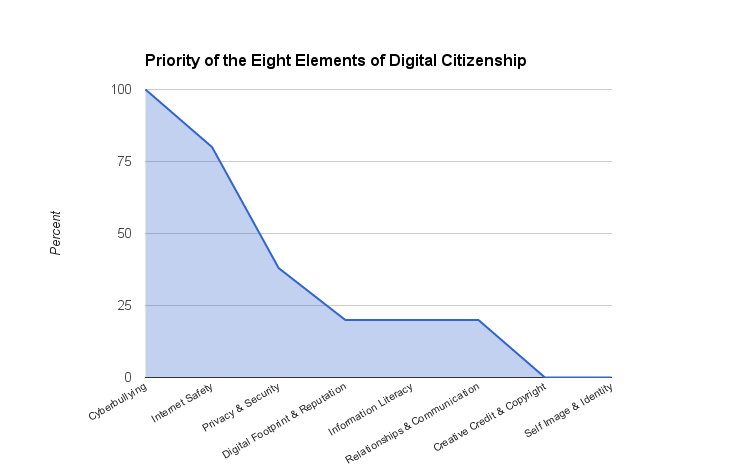
The picture painted by some of the early data shows that the local education agencies are at various places with respect to a shared vision of digital citizenship implementation in the classroom. It appears that a shared vision within districts is not the norm, which should prompt concern among all stakeholders. The way in which respondents prioritized the eight elements of digital citizenship is also notable. To be consistent in the delivery of digital citizenship, is any element more or less important than the other?
This project holds promise for bringing together districts from across Arizona and providing talking points that could lead to positive collaboration and common language among educators. We should applaud the effort and look forward to the data.

Moving Forward
It is becoming clearer everyday that digital learning is on the rise, even if our schools do not provide these opportunities. The 2014 SpeakUp Survey showed that 75 percent of students think every student should have access to a mobile device during the school day to support learning. Many of them have taken matters into their own hands, as 58 percent already use their own smartphones in class and perform such tasks as taking photos of assignments and textbook pages.
So where do we start with such an overwhelming responsibility that affects our classrooms and the teachers that ultimately set the example for our students? A quick Web search will return numerous sites with digital citizenship resources. Common Sense Media is a popular choice and offers scope and sequence materials that are age appropriate for the classroom and a certification program for educators and schools. It takes much more effort, however, to find actual programs that exist in schools-examples of digital citizenship embedded in those teachable moments that are so relevant to our students. We need to shared successful programs and hold them up as models for others to see (#digitalcitizenship).      


A Partnership
Digital citizenship is no different from good citizenship in general-the only distinction is the medium where that community exists. If we expect our students to be responsible members of the digital community, we have to collaborate with all stakeholders to create successful learning opportunities, encourage parental support, lead by example, and include our students in that discussion. Technology is no longer a once-a-week event or a trip to the computer lab; it is embedded in our classroom and personal environments. It will take more than the librarian or tech teacher to instill the values of digital citizenship into the lives of our students and make good digital citizenship part of the Big Four.

Sunday, February 21, 2016

Move Over Flair

Time...
https://creativecommons.org/licenses/by/2.0/
Probably the most common issue we hear about in life has to do with not having enough time for, and fill in the blank. Often the counter to that statement is we will make time for what is important, which is true to an extent, but doesn't change the fact that in our professional lives we still must prioritize. What has been a struggle for a number of years now from a technology integration perspective, is how we provide solid professional development to our teaching staff that is relevant, timely, and doesn't require the traditional hour before or after school that teachers may not have time for. 

Short Meaningful PD
I like to use the average length of a YouTube video to provoke discussion on just how long someone will stay with you when providing PD. Depending on what day you check, the average length of the top five most popular YouTube videos vary from 2.5 to 4.5 minutes long. When I checked #popularonyoutube when writing this post, the longest video was 5.31 and the shortest was 31 seconds. I would imagine that some may say if the content is good, it doesn't matter how much time it takes to view and to some extent that may be true. However in the hustle and bustle of the K-12 setting, moving at the pace of 140 characters at a time seems to make more sense if we want to reach a larger audience. At AJUSD we have made the conscience effort to change the way we are providing PD to our teaching staff that provides short, meaningful bursts of sharing content while staying as close to the 15 minute window as possible. Bethany Ligon, AJUSD's Technology Integration Specialist, has taken this approach with our collaboration coach tips and tools videos recently and we are monitoring feedback on video length to see what is most effective for our staff. 

Badge Up
Another area that takes time and attention is growing our professional learning networks and sharing what our teachers and administrators are doing on their campus. Social media has obviously been a game changer in this area and blending this with the traditional walking by a classroom and seeing evidence of the great things happening, has led us into the badge game. It is difficult for just one district TIS, to get around to every classroom and see what is happening. With a quick Google Site and Forms, teachers and administrators can apply for a badge, share their artifacts, display their accomplishment, and share with others how they are integrating technology in their classrooms. Bethany summed up nicely what she enjoys most about implementing this program:

The best part for me, is that teachers are able to request training on exactly what they want. It's not a one size fits all professional development setting anymore. But it's me meeting with one teacher or a small team of teachers who want to grow their instructional toolbox in a specific area or with a particular tech tool/app. And because I now have documentation on which teacher is proficient on each tool, I can use them as a resource as needed. 
Another "best part" for me is the teacher's reaction when I walk into their rooms on a Thursday afternoon to hand them their badge. Yesterday, a teacher literally jumped up and down and clapped her hands because she was so excited and then her little first graders started cheering for her. That totally made my day.

Find A Way
Time doesn't have to be a monster that keeps us from growing and sharing on a professional level. If we look around and see what others are doing, share what we are doing, and be willing to try new things, great things will happen. In the words of Ian Malcolm, life finds a way. 

Thursday, July 9, 2015

ISTE Gems!

The Stack
Every year I return from ISTE with a backpack full of information and a google doc filled with session notes. Like everyone else who has been to ISTE over the years, I have come to find that the connections made during the conference are invaluable, but there is still a benefit with sharing the little gems with others who didn't attend. These are just a few highlights that I found in my pile of "stuff".

Maker Movement
I think it is safe to say that Raspberry Pi has made a dent in the maker movement, and allowed students to learn programming skills, create technology rich projects, and not break the bank in the process. At the Raspberry Pi + iPad session, Mike Amante did a great job sharing his experiences with the device and how he is using the technology with his students and plans of expanding the program in the fall. More information from Mike can be found here. A big surprise at the end of the session were two representatives from the Raspberry Pi Foundation showed up and shared news about Picademy USA, you can find more info here.

Innovators Mindset
If you have ever listened to or follow George Couros, then you understand that he has a great way of using short, but thoughtful statements that make you really think about education and what it could be. I always try and catch one of his sessions at ISTE because he never fails to provide great thoughts that can easily be shared at admin meetings, staff meetings, or lunch time conversations. Here are a few (as accurate as I could be) that he used in the session Developing the Innovators Mindset.
  • Relationships are the most important piece in schools now and in the future
  • Biggest barrier is our own way of thinking
  • Think different
  • Digital factory model is still factory model
  • Technology is more than a tool
  • Technology can be transformational in hands of a great teacher
  • Would you want to spend all day in your own classroom
  • Everyone is a teacher and a learner

The PLN
One of the hardest thing for many educators to do is build their PLN. Taking that first step from
Courtesy Roy Blumenthal CC 2.0
picking which social media platform to venturing out of the four walls of the classroom can be scary, but absolutely necessary to grow as an individual. The session, The Passionate PLN, by Jessica Raleigh, was a very informative hands on experience that introduced Twitter to everyone as a way to connect and make a difference. A highlight was The Breakfast Club, #BFC530, as a place to participate in a one question twitter chat, every weekday at 5:30am. If you are looking to build your PLN  and connect with others, give it a look here.

ISTE 2016
The ISTE conference has a little something for everyone and is consistent with the variety of sessions that makes it a good destination. If you are an educator looking for an event with options, want to grow your PLN, and meet like minded peers, then I would recommend educating your school boards and administrators on the opportunities ISTE has to offer. But remember, finding local events, lunch and learns, Twitter chats, coffee on a Saturday morning, also provides collaborative time and opportunity for connections to help us grow professionally. Get out of those four walls and see what others are doing and share!

Wednesday, October 22, 2014

How Many Times?

Just Ask
How many times have you heard an adult say "just ask the students how to do it" when talking technology in the classroom or anywhere for that matter? I will admit that when I need a tip about making my Instagram posts look better I ask my 11 year old daughter, and when my son rolls his eyes at me and says "you just don't understand", about what kids are watching on YouTube, I ask him to explain. I have experienced a few situations lately that have reinforced the notion that just because kids are kids, doesn't mean they understand technology.


Here's an Idea
Recently at home I upgraded our video editing software and it had been awhile, so it jumped a few versions. My son's passion right now is creating videos of his friends video game activity, which prompted the "you just don't understand" when I asked him why. At any rate, I knew he would spin out when he realized how different the suite now looked. He took it in stride though and worked through the changes with one issue, the software was horribly slow. I gave the standard answer, Google the problem and see if others are experiencing the same thing. That was met with resistance and why don't we just go back to the old version. The real issue however wasn't that he was trying to avoid the problem, but he didn't understand where to begin or how to intelligently "Google" the problem. I assumed he had already opened up task manager to check how much processing power was being used, what percentage of memory was available, was the program producing any error messages, etc. Once we sat down together and started looking closer, we found the program was scanning the entire my documents folders for pictures and videos, and slowing things down. Problem solved and valuable lesson learned about trouble shooting a software issue.


Don't Assume


We must be careful not to assume just because kids are kids they know everything about technology. I see students struggle to access their Google Apps account and create a document, share it with their peers and collaborate efficiently. These skills seem simple on the surface and any student should be able to do this, but many can not. As educators we must find ways to have these teachable moments in our classrooms. As administrators we must make sure that our teachers have the training, devices and resources to make this happen. Our students today are as just as smart and motivated as any generation has ever been, they just need that little bit of guidance and then they will go and make it even better for tomorrow.


Thursday, November 7, 2013

Dump Truck Model

Back Up

Models haven't changed much over the years when it comes to implementing technology in our schools. I have by not been perfect by any means, but have learned a few things along the way that I use as guiding questions before making implementation decisions. However often circumstances seem to get in the way and decisions are made that produce large blanket purchases of technology that is hastily thrown into classrooms. We have seen this happen many times and on such a large scale that it gathers negative press when things don't go oh so perfect. My concern with the dump truck model is the negative impact it could have on the smaller roll outs that generally take more effort to set in motion.

Celebrate
Don't get me wrong, there are any number of large roll outs around the world that have been well planned and executed and remain a model for others to follow. It is those scenarios that we need to celebrate and hold up as examples to promote the importance of providing our students the relevant environment they deserve. The recent publicity that LAUSD has received with their billion dollar ipad initiative is one that is too big to fail. Without being involved in such a gigantic project, I can only reserve judgment on why they have had their issues, but it has drawn attention and gives the nay sayers fuel that is unfairly used in other situations. LAUSD will work out their issues and find success, they have to, and it will benefit other educational technology projects in many ways. Many of us do not have the resources that larger districts possess and having a successful model with resources to share is important for success outside of LAUSD.

Take Steps
I did a quick search for "steps for implementing technology" and had a wide range of returns, which included a variety of business world ideas also. One article that held my attention was titled, "Eight steps for implementing a technological overhaul", written by Ken Tysiac and highlighted the work of author and consultant Geoffrey Moore. Although the focus was business, many of his eight points easily cross over to the K-12 environment and I have highlighted a few below that I feel are very relevant to implementing a successful technology implementation.

  • Determine which tools would have the biggest impact on effectiveness in those key moments with clients.
  • Calibrate ambitions with their organization’s technology adoption tendencies, such as whether employees tend to be innovators, pragmatists, or conservatives.
  • Recruit to the effort first those employees who tend to embrace new ideas.
  • Engage with outside help to design and prototype the first new tools for communications and interactions
  • Focus on user experience as the critical acceptance criterion.
  • Get feedback from early adopters to create the case for applying the system to more pragmatic, less enthusiastic adopters.
  • Align the technology to solve a particular issue that causes the pragmatists pain, and do whatever it takes to solve that issue.
  • Once pragmatists are convinced, deploy a global roll-out.

Moore's ideas were addressing a specific need for client employee relationships and did not include the initial employee input on the best tools to address the need, which is something we rely on in the K-12 space, or should. But the idea of recruiting the high flyers that are always willing to embrace new ideas and listening to their feedback is critical.

It is difficult not to take advantage of grants, overrides, large funding sources of any kind when they present themselves. My hope is that the dump truck model is put in perspective and the audience, early adopters, and their feedback is kept in mind before that familiar sound is heard...beep...beep...beep. 

Sunday, June 9, 2013

Social "Media" Bigfoot

Footprint
Here are a few questions that I often hear when social media is being discussed that deserve some attention.

  1. What is a social media footprint?
  2. How big should it be?
  3. Why do I care?

The Numbers
From a pure numbers perspective, it seems to make sense that jumping into the social media landscape can be a benefit to the professional growth model. Facebook currently has over a billion active users a month alone, even if you discount that 100 million of those users are pets, objects, or brands, 900 million is alot of humans. Twitter has 554,750,000 active registered twitter users that tweet on average 58 million times a day according to Statistic Brain.  As of January, 2013, Linkedin reached 200 million users, "LinkedIn now counts over 200 million members as part of our network, with representation in more than 200 countries and territories. We serve our members in 19 languages around the world." Google+ is a bit harder to get a true read on numbers, but even if we go with 135 million users actively posting to Google+ Pages, that is no small number.

Why Do I Care
All the numbers above can be dissected, debated and manipulated for company purposes but I see them as an opportunity to connect with others that run in the same professional circle as myself (no pun intended). I care about growing as an individual and bringing new ideas into the workplace and sharing my successes with others, which is easily done through social media.

                                        How Big
The size of your social media footprint depends on your comfort level in this arena. Some can juggle multiple feeds while others feel overwhelmed with more than one. My suggestion is take your time and find what works for you, and use technology to help you organize. There are a number of programs out there that will help you streamline your feeds and better manage the large amount of information coming in and out of your busy day. HootSuite is one that I have found to be very helpful for me and worth a look if interested in managing multiple streams.

Give It A Try
We often hear the saying that you have to get out of the four walls of your classroom or office to see what is happening out there. That is a true statement as we all know that sharing, collaborating and having an open mindset will help us grow as individuals. To grow professionally you have to care, why not use social media as one option to step outside those walls.

Saturday, April 14, 2012

Been A While

Been A While
courtesy of Arndt Nollau
It has been quite some time since my last post, a little over three months actually. I would imagine that is probably a bit to long in between posts, but the inspiration to write has been lacking. In my opinion, it is probably better to take a break than force something that just isn't there. Lacking the motivation to blog is not any different than becoming stagnant with other things in life, even in the workplace, where there are numerous things to keep us busy. So how do we stay motivated, inspired, full of enough energy to keep innovating and moving forward at work or anywhere for that matter?


courtesy of Bjorn Hermans
Get Out...
of the four walls of that office or classroom and start building your personal learning network! The greatest source of inspiration for me comes from others that I am connected too. It can be virtual connections or face to face, but sharing thoughts, ideas, and opinions with others will contribute to your professional development and knowledge. And (not sure that is grammatically correct), we all need support, information in today's world comes at such a rapid pace it is impossible to keep up without a network.


Where Do I Start?

The first step in any new adventure is the hardest part, but let's just be honest with ourselves here, you are not climbing a 500 ft. cliff without a rope, or walking a tightrope with no safety net, you are looking for individuals that share a common denominator. If in a classroom or office, prop your door open and say hi to your colleagues as they pass by, maybe they will drop in and you can talk about what they have planned for the day. Jump into the Social Hurricane and build your PLN virtually through social media. Find a group that is outside of your school walls but maybe local in your state (AzTea, AZ CIO/CTO, @azk12) or venture out to the national organizations (ISTE, COSN, TLN)!

Big Thanks

I want to thank the AZ CIO/CTO group for being a big part of my PLN. The passionate, diverse, thought provoking contributions by this great group has been very helpful in building my professional development and knowledge. The recent activity on the list serv is what inspired me to get back to my blog, thanks all.

Saturday, December 3, 2011

The Administrator Superhighway

I wrote this article for the ISTE Sig-Admin Winter Newsletter, and thought I would put it in my blog as well.

Have you ever driven on a freeway system that is so confusing due to the complex looping off-ramps, the over and under, and super high speed lanes that require exotic foreign sports car to navigate? Even with GPS I seem to add a few extra miles onto each destination when I venture out of AZ and into other states with more freeway twists and turns than I am accustomed to. As an administrator in today’s K-12 environment, there are many different off-ramps and high speed lanes to choose from when considering your leadership goals and how it will influence your organization.

Visionary Leadership ISTE NETS for Administrators (NETS•A): Educational Administrators inspire and lead development and implementation of a shared vision for comprehensive integration of technology to promote excellence and support transformation throughout the organization.


Sounds simple enough, right? Any successful organization probably has a leader that can inspire, create vision and put practices in place to reach a goal, but how many other “leaders” are influencing that person? In my position as Director of Technology, in the Apache Junction USD, I feel the Superintendent has created an environment that allows departments, school staff, and students to collaborate, share, and influence the direction of the organization. Let’s take a closer look at a few areas that support the road to visionary leadership.

Fear of Failing
There are a number reasons why people are afraid to change, try new things, and influence others around them. Two specific reasons that come to mind are:
  • The fear of failure itself
  • Staff members are not encouraged to fail
The end result of the fear of failure can lead to a stale environment and innovation will be put aside for sustaining old practices. Learning how to fail while maintaining the confidence to adjust and move forward is essential to creating a successful learning environment. I want to share an experience that Tracy Watanabe, Technology Integration Specialist for the Apache Junction USD, shared with me about failing.

“Early last summer, I was asked to do a presentation in a short webinar. I had never been involved in a webinar before, but figured it would not be very different from all of the professional developments I facilitated every week. Boy was I wrong. My computer froze 10 minutes before I was supposed to start, and my backup computer did the same. I was so nervous by the time my computer was rebooted, that I didn't remember what I said, how fast/slow I was talking, and couldn't read my audience, which is something I rely strongly on. I felt like I let everyone down. I was ready to write off webinars as something that was not for me. Luckily, I'm surrounded by others who believe that failing is just a milestone on the path of improvement Fail, Learn, Try Again. When I shared my webinar experience with my boss, and other peers, their feedback was encouraging and inspired me to try again. Recently I facilitated a webinar as part of the Edublogs Serendipity webinars. It wasn't perfect, but that didn't seem to bother anyone, including myself because it's part of the learning process. Next time is an opportunity for improvement. Isn't that what it's about? You see, to grow and improve is like a journey. Failures along the way are just milestones on that journey. Failures aren't the destination, and a journey without failures means you're not traveling far from the safe zone. It takes venturing out of the safe zone to grow and improve.

Good Teaching vs. Shiny Object
Digital-Age Learning Culture ISTE NETS for Administrators (NETS•A): Educational Administrators create, promote, and sustain a dynamic, digital-age learning culture that provides a rigorous, relevant, and engaging education for all students.

Building and promoting a digital-age learning culture can be difficult with the rapid change of technology. Every week a new shiny device is released and it can become distracting from the educational goals of a district, unless the focus is on good teaching and not the device. The device type will continue to change, but good teaching must remain constant and use whatever tool best meets the needs of their students. Take the time to collaborate and create a foundational plan that will guide good teaching practices that support the learning goals. The “College Readiness for All” is our foundational guide in the Apache Junction USD.

Role of IT
As we continue down the administrator superhighway we have to ask ourselves what role every department and staff member plays in supporting the foundational plan that is guiding good teaching. As a Technology Director, I feel that the
Role of IT can have a tremendous impact on a district’s educational plan. IT staff spend many hours in classrooms and cannot make it across a campus without being asked a question by staff and students. The days of IT staff just replacing a video card or upgrading operating systems are becoming a thing of the past. I recently asked my Superintendent what his thoughts were on the role of Technology Directors in the K-12 environment and this was his response.

“The Director of Technology can absolutely play a significant role in helping influence change within the district if he or she assumes the role of instructional leader. Many of today’s school systems are technology-rich, especially compared to just ten years ago. But technology in and of itself won’t improve student achievement. Putting computers, Smart Boards, Doc Cameras, etc., in classrooms without first developing teacher capacity to utilize these tools to create authentic, learning opportunities will do little to change our current school systems.

Great technology, paired with excellent teaching, is what will provide students a better opportunity to learn. This is where the Director of Technology can have a huge influence on change. By being an instructional leader, Directors of Technology can help districts keep a balance on first, good teaching, and then second, how technology can be utilized to provide students with quality learning opportunities. Directors of Technology should be instrumental in shaping professional development opportunities for classroom teachers, focus the conversation about how/what technology should be utilized to support quality teaching, how dollars should be utilized when purchasing technology, how technology fits into a school/district strategic plan, etc. By fulfilling this role, the Director of Technology will absolutely influence change in school districts for the benefit of all.”

Put Me in Coach
Excellence in Professional Practice ISTE NETS for Administrators (NETS•A):
Educational Administrators promote an environment of professional learning and innovation that empowers educators to enhance student learning through the infusion of contemporary technologies and digital resources.

Administrators must model the practices that they want to see happen in the classroom, but who can help support the teachers on a daily basis. One Technology Integration Specialist was not going to be able to support 6 schools by herself in my school district, so we turned to the Microsoft Peer Coaching model developed by the
Peer-Ed team. The focus with our collaboration coaches is first on good teaching, aligned to our College Readiness for All plan, with technology embedded in the instruction. If administrators are going to “allocate time, resources, and access to ensure ongoing professional growth in technology fluency and integration” they will need support from departments, staff, and peers to make this happen, peer coaching is an off-ramp worth taking.

The Real Leaders
I hope that you have enjoyed the ride down the road to visionary leadership on the administrative superhighway! The off-ramps I have discussed are few among many that make up the complex K-12 environment in our technology rich world. As long as we keep the real leaders at the center of all decisions, the students, the K-12 landscape will continue to evolve and still be the goal that all others strive to achieve.


Monday, June 13, 2011

Change Can Happen

Setup
Recently I wrote about professional development and my district's "Summer Academy" activities. There were a number of district participants and presenters, one being Tracy Watanabe, AJUSD's Technology Integration Specialist. She spent one of her days working with the teachers at CCJH, the district's Jr. High, where we have just finished the first year of a 1:1 program with the 7th grade. Next year the incoming 7th graders will step right into the 1:1 environment and the school will be 1:1 all the way through.

The Growth
There have been a number of amazing transformations take place at CCJH during the year and worth noting, but one of Tracy's activities just grabbed my attention. She had small groups of teachers take the district's "College Readiness for All" plan and make the connection to the

ISTE NETS-S. There was great collaboration between the groups and the way they chose to share their information was also very impressive. They had little time to complete the task and the three groups below all chose different forms of multimedia for sharing.

Culture Change
One short year ago this activity would have not yielded the same results. Not sure how many teachers would have known what the NETS were and sharing would have probably been on a piece of butcher paper or maybe a powerpoint. The culture at CCJH has changed and there are a number of reasons, great teachers, principal, support staff, district support, board support, that can be attributed to this. The overall point that I guess I'm trying to make is, things can change in the K-12 education setting, you just need to be willing.


Thursday, June 2, 2011

Great PD or Waste of Time?

Don't Waste My Time
What is the first thing that you think of when you hear the words professional development? I have heard different things from teachers like:
  • training for the latest trends
  • required
  • waste of time
  • I didn't learn anything
  • another top down activity
  • how will this help me become a better teacher
All these points are valid and make great questions when planning professional development activities. If we are going to ask teachers to give up their time, professional development should be aligned to district/site goals, based on teacher needs, and ultimately have an impact on student learning.

Great Week of PD
For quite some time now we have provided a summer academy in our district the following week school is out for break. The week has been well received and the feedback provided has always been positive for the most part. This year's summer academy is coming to an end and there has been many amazing sessions that has allowed teachers to work with their colleagues from around the district. There were 77 individual sessions offered over the course of 4 days and 65 of those were technology based. Ongoing professional development for the 1:1 program at CCJH continued with Tracy Watanabe and Nick Sauers and the first 1:1 training for AJHS was also conducted by these two amazing individuals.

Thank You
I want to thank all that have been involved in making this week a great success and look forward to the continuation of meaningful professional development in AJUSD.